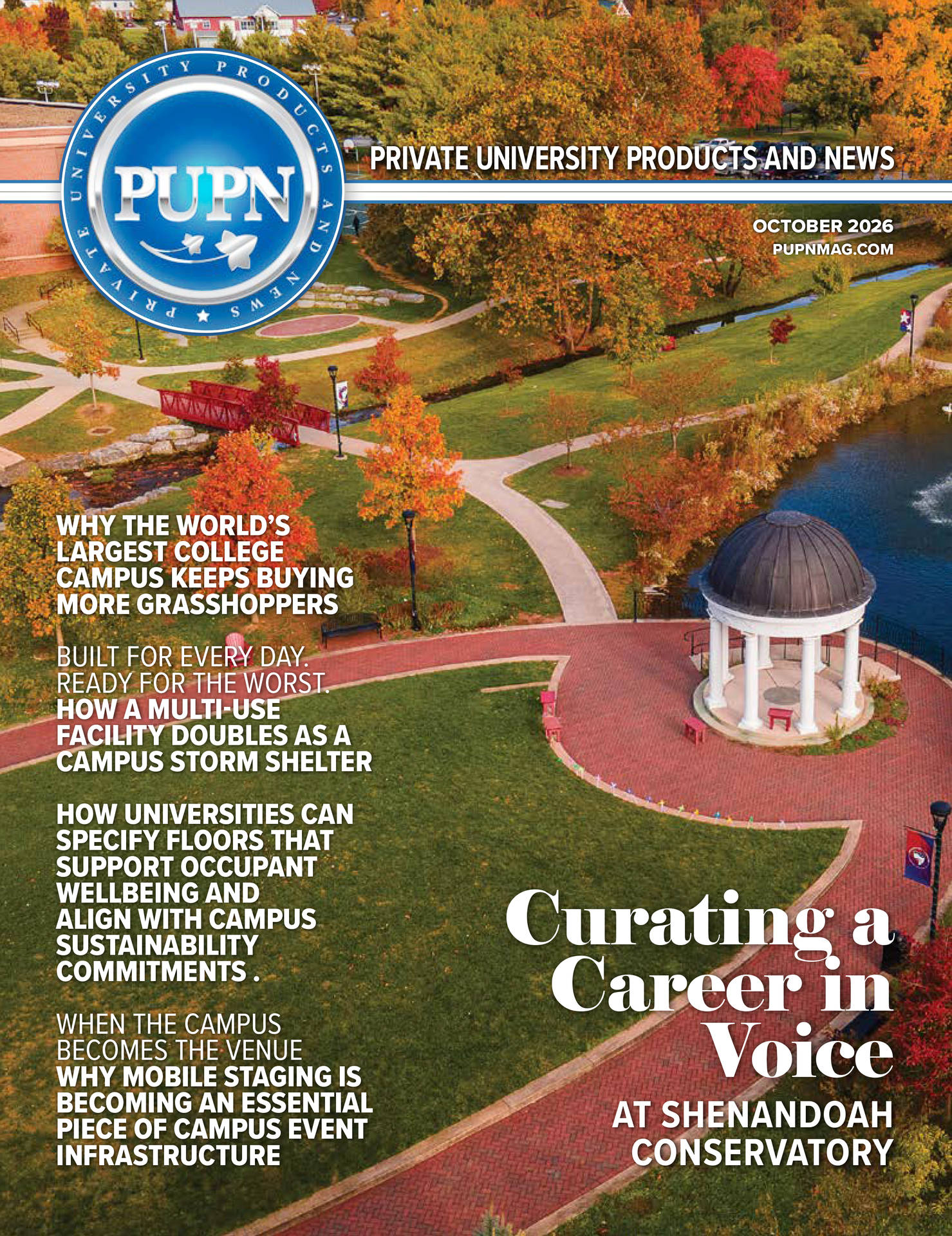





For private colleges and universities, where the demand for memorable campus experiences continues to stretch beyond traditional venues, a mobile stage can turn almost any outdoor space into an event destination. From commencement and homecoming to student concerts, athletic events, alumni gatherings and admissions programs, the right mobile stage can become a surprisingly versatile piece of campus infrastructure.
In this month’s PUPN feature, we talked with Todd Allison of Progressive Products in Pittsburgh, Kansas, about why colleges are taking a closer look at mobile stages—and how the right investment can deliver flexibility, savings, safety and more opportunities to bring campus life outdoors.
A STAGE FOR MORE THAN ONE EVENT
PUPN: Why should private colleges and universities consider a mobile stage as an essential piece of their campus event infrastructure rather than simply an occasional-use purchase?
Todd Allison: For private colleges and universities that host commencement activities, homecoming events, student organization programs, concerts, donor gatherings, admissions events, and community functions throughout the year, that flexibility creates value well beyond an occasional special event.
With a mobile stage, the school has a consistent, professional event platform without repeatedly renting temporary staging and coordinating outside crews.
Just as importantly, owning a mobile stage gives the university greater control over scheduling. When an event changes locations, a new program is added, or an opportunity comes up on short notice, the campus already has the infrastructure available.
Over time, the stage becomes less of an event purchase and more of a shared campus resource that can support student life, advancement, athletics, admissions, and community engagement.
FLEXIBILITY IS THE BIG ADVANTAGE
PUPN: What are the biggest advantages of a mobile stage compared with constructing or renting a permanent stage for campus events and performances?
Allison: Mobile stages have the great advantage of flexibility. The stage can be moved to any place on campus.
Not only is this a great way to support events across campus, but it can also be moved to locations that can better accommodate events of various sizes. The stage isn’t locked into one location, so neither is the event.
Furthermore, the stage can be used for off-campus activities—like a parade stand or for a community outreach event.
BRINGING THE EVENT TO THE PEOPLE
PUPN: Private colleges often host a wide variety of events—from concerts and commencement ceremonies to athletic events, student activities and community gatherings. How does a mobile stage provide the flexibility needed to accommodate these different uses?
Allison: A mobile stage gives colleges the flexibility to bring a professional event space directly to where it’s needed.
Instead of designing every event around a permanent venue, the stage can move from the campus quad for a student concert to an athletic complex for game-day activities, then to another location for commencement, homecoming, alumni events, or community programs.
That mobility also allows schools to make better use of existing outdoor spaces. Parking lots, lawns, courtyards, and athletic fields can quickly become event venues without building permanent infrastructure.
Because the same stage can support everything from a small student activity to a large campus celebration, a mobile stage becomes a multipurpose resource that can serve numerous departments and organizations throughout the year.
It gives the university more options for where, when, and how it hosts events.
WHEN THE STAGE CAN PAY FOR ITSELF
PUPN: From a financial perspective, how can investing in a mobile stage help a university reduce long-term events and staging costs, particularly when compared with repeatedly renting temporary staging?
Allison: It is more cost effective to own a stage than rent a stage. And the time to set up a mobile stage is less than setting up a manual outdoor structure.
A small mobile stage can be paid for in as few as 20 weekend events. In our area, that is less than a two-year payback.
Furthermore, banners on the stage can generate revenue through advertising and sponsorship income. Not only can a stage pay for itself, but it can also be an ongoing revenue stream that helps fund student activities.
LOOKING BEYOND THE PURCHASE PRICE
PUPN: What should facility managers look for when selecting a mobile stage in terms of durability, setup time, transportation, storage, weather resistance and overall ease of use?
Allison: Facility managers should look at a mobile stage as a long-term investment, not just an event-day purchase.
Durability matters, so the stage should be built to handle frequent use, transportation, changing weather conditions, and years of setup and teardown.
Ease of operation is just as important. A well-designed mobile stage should deploy quickly with a small, properly trained crew and minimize complicated assembly or loose components. Faster setup not only saves labor but allows campus staff to respond more easily to changing event schedules.
Transportation and storage should also fit the realities of the campus. Managers should consider the tow vehicle required, overall trailer dimensions, maneuverability through campus streets and parking areas, and where the stage will be stored when it isn’t being used.
Finally, look closely at weather ratings, structural design, safety systems, maintenance requirements, and manufacturer support.
The best mobile stage for a college is one that staff can confidently transport, set up, operate, maintain, and store without turning every event into a major production.
CREATING MORE CAMPUS EXPERIENCES
PUPN: How can a mobile stage enhance the student experience and support campus life by giving student organizations, athletic departments and performing arts programs more opportunities to host events?
Allison: A mobile stage can help turn more areas of campus into places where students can gather, perform and connect.
Instead of limiting events to traditional auditoriums or permanent venues, colleges can bring a professional event space directly to quads, athletic areas, parking lots and other outdoor locations.
That flexibility creates more opportunities for student organizations to host festivals, rallies and special events; athletic departments to enhance game-day and tailgating activities; and performing arts programs to take concerts and performances outside the traditional theater setting.
Most importantly, a mobile stage can make it easier for students to turn ideas into actual events.
By removing some of the logistical barriers associated with temporary staging, colleges can support a more active campus calendar and give students more opportunities to participate, perform, organize and build traditions that strengthen campus life.
SAFETY FIRST
PUPN: Safety is a major concern for campus facility and event managers. What safety features and certifications should colleges and universities consider when evaluating a mobile stage?
Allison: Safety should be one of the first considerations when evaluating a mobile stage.
Colleges should look for a stage that has been professionally engineered and comes with clear documentation for structural capacity, wind limitations, allowable rigging loads, guardrails, stairs, handrails and proper leveling and stabilization.
It is also important to understand which recognized building, structural, electrical and fire-safety standards apply to the stage and to the jurisdiction where it will be used.
Safety matters just as much as engineering. Features such as secure locking systems, clearly identified setup procedures, adequate fall protection and straightforward leveling can reduce the opportunity for mistakes.
The manufacturer should also provide thorough operator training, inspection guidelines and maintenance procedures.
Ultimately, a safe mobile stage is more than a well-built structure. It is a complete system supported by good engineering, proper documentation, trained operators and clearly defined operating limits.
WHERE MOBILE STAGING IS HEADED
PUPN: Looking ahead, how do you see mobile stages evolving to meet the changing needs of private colleges and universities, and what advice would you give campus decision-makers considering an investment today?
Allison: Mobile stages will continue to evolve toward faster setup, simpler operation, greater versatility and improved safety.
For colleges and universities, that means stages that require smaller crews, accommodate more production equipment and can adapt to everything from an intimate campus gathering to a major commencement or concert.
We will also likely see greater integration of technology, improved weather monitoring and more efficient electrical, hydraulic and control systems.
For campus decision-makers, the key is to think beyond the next event.
Consider how the stage could serve the entire institution over many years and involve the departments that are likely to use it—facilities, student life, athletics, performing arts, advancement and admissions.
Most importantly, don’t evaluate a mobile stage on purchase price alone.
Consider ease of operation, labor requirements, transportation, maintenance, manufacturer support, available accessories and the ability to adapt as campus events change.
A stage that is easy to use and flexible enough to support many departments can become a valuable piece of campus infrastructure rather than simply another piece of event equipment.
THE STAGE IS ONLY THE BEGINNING
The real value of a mobile stage may have very little to do with the stage itself.
It is about what happens when a college can say “yes” to more events, more locations and more opportunities to bring students and the campus community together.
As Allison explains, a mobile stage can move wherever the action is—from the quad to the athletic complex, from a parking lot to an outdoor celebration—and serve departments across the institution. Student organizations gain another place to gather. Athletics can create a bigger game-day experience. Performing arts programs can take performances outside the traditional theater. Advancement and admissions can create memorable events for alumni, donors and prospective students. And facility managers gain an asset that can be used again and again rather than serve as a temporary solution for a single weekend.
But flexibility doesn’t mean sacrificing the fundamentals. Durability, safety, weather resistance, setup time, transportation, storage, training and manufacturer support all deserve a place at the decision-making table.
The smartest approach is to look beyond the next event and consider how a mobile stage could serve the entire campus for years to come.
Because sometimes the best way to create a new campus gathering place isn’t to build another building.
It’s to put the stage on wheels.